The Real Lincoln by Thomas DiLorenzo
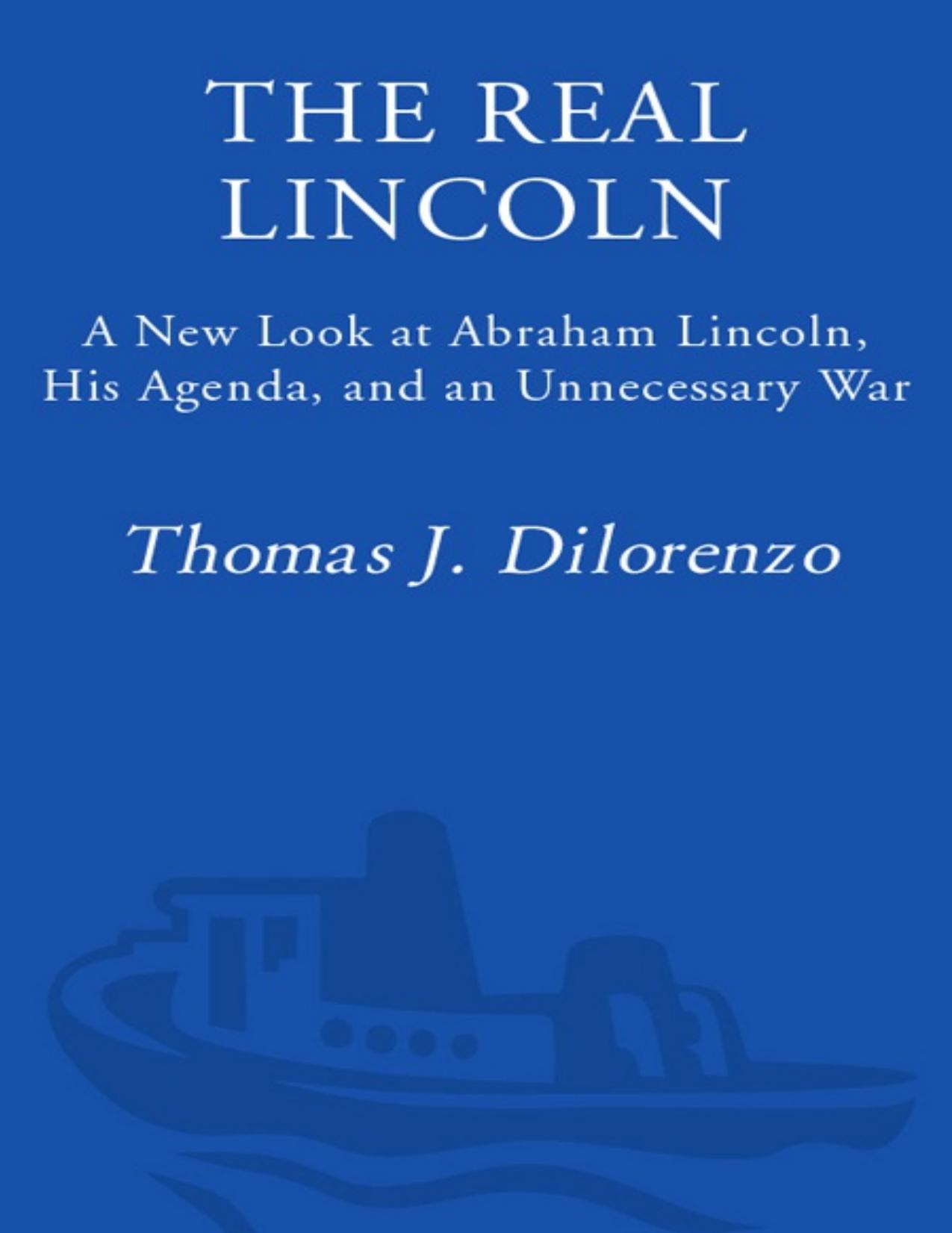
Author:Thomas DiLorenzo [Dilorenzo, Thomas J.]
Language: eng
Format: epub, mobi, pdf
ISBN: 978-0-307-55938-8
Publisher: Crown Publishing Group
Published: 2003-03-25T16:00:00+00:00
Of course, the Constitution was always meant to be a “straight-jacket” worn by enterprising politicians who, the founders understood, could never be entirely trustworthy in protecting the lives, liberties, and property of the people from the temptations of special-interest politics. Jefferson himself spoke of “binding” government in “the chains of the Constitution.” Randall reveled in the fact that that philosophy was effectively overthrown by Lincoln. As David Donald has remarked, once Lincoln became a martyr, politicians of all parties began invoking his example as “justification” for more and more unconstitutional power grabs, often making the politically unanswerable argument that “Lincoln did it; how could anyone object?”
In Fate of Liberty: Abraham Lincoln and Civil Rights, Mark E. Neely, Jr., observed that as early as the 1840s Lincoln, one of the most ambitious politicians in American history, was seething with resentment over the fact that the constitutional arguments stood in the way of the Whig economic program and his vaunted American System. At that time, writes Neely, “Lincoln appeared to be marching steadily toward a position of gruff and belittling impatience with constitutional arguments against the beleaguered Whig program.” 69
The Federalist/Whig program of protectionist tariffs, nationalized banking, and government subsidies for corporations was foiled for sixty years by strict constructionist interpretations of the Constitution (see chapter 4). Once he and the old Whigs were finally in power, Lincoln was not about to let the Constitution stand in his way.
In 1962 literary critic Edmund Wilson compared Lincoln to Lenin and Otto von Bismarck because Lincoln granted himself dictatorial powers in order to usher in a highly centralized state, just as the other two had done.70
The nineteenth century was the century of governmental consolidation, especially in Germany, Russia, and the United States. As Wilson explained,
The impulse to unification was strong in the nineteenth century… and if we would grasp the significance of the Civil War in relation to the history of our time, we should consider Abraham Lincoln in connection with the other leaders who have been engaged in similar tasks. The chief of these leaders have been Bismarck and Lenin. They with Lincoln have presided over the unifications of the three great new modern powers… Each established a strong central government over hitherto loosely coordinated peoples. Lincoln kept the Union together by subordinating the South to the North; Bismarck imposed on the German states the cohesive hegemony of Prussia; Lenin… began the work of binding Russia… in a tight bureaucratic net.71
Download
The Real Lincoln by Thomas DiLorenzo.mobi
The Real Lincoln by Thomas DiLorenzo.pdf
This site does not store any files on its server. We only index and link to content provided by other sites. Please contact the content providers to delete copyright contents if any and email us, we'll remove relevant links or contents immediately.
The Vikings: Conquering England, France, and Ireland by Wernick Robert(84381)
Ali Pasha, Lion of Ioannina by Eugenia Russell & Eugenia Russell(40318)
The Conquerors (The Winning of America Series Book 3) by Eckert Allan W(37983)
The Vikings: Discoverers of a New World by Wernick Robert(37006)
Cecilia; Or, Memoirs of an Heiress — Volume 1 by Fanny Burney(32636)
Cecilia; Or, Memoirs of an Heiress — Volume 2 by Fanny Burney(32010)
Cecilia; Or, Memoirs of an Heiress — Volume 3 by Fanny Burney(31996)
Empire of the Sikhs by Patwant Singh(23135)
The Secret History by Donna Tartt(19296)
Hans Sturm: A Soldier's Odyssey on the Eastern Front by Gordon Williamson(18649)
Cat's cradle by Kurt Vonnegut(15441)
Pimp by Iceberg Slim(14666)
Sapiens: A Brief History of Humankind by Yuval Noah Harari(14461)
Norse Mythology by Gaiman Neil(13458)
Talking to Strangers by Malcolm Gladwell(13440)
Leonardo da Vinci by Walter Isaacson(13411)
4 3 2 1: A Novel by Paul Auster(12513)
Underground: A Human History of the Worlds Beneath Our Feet by Will Hunt(12145)
The Radium Girls by Kate Moore(12093)
